


Loading…
Loading…
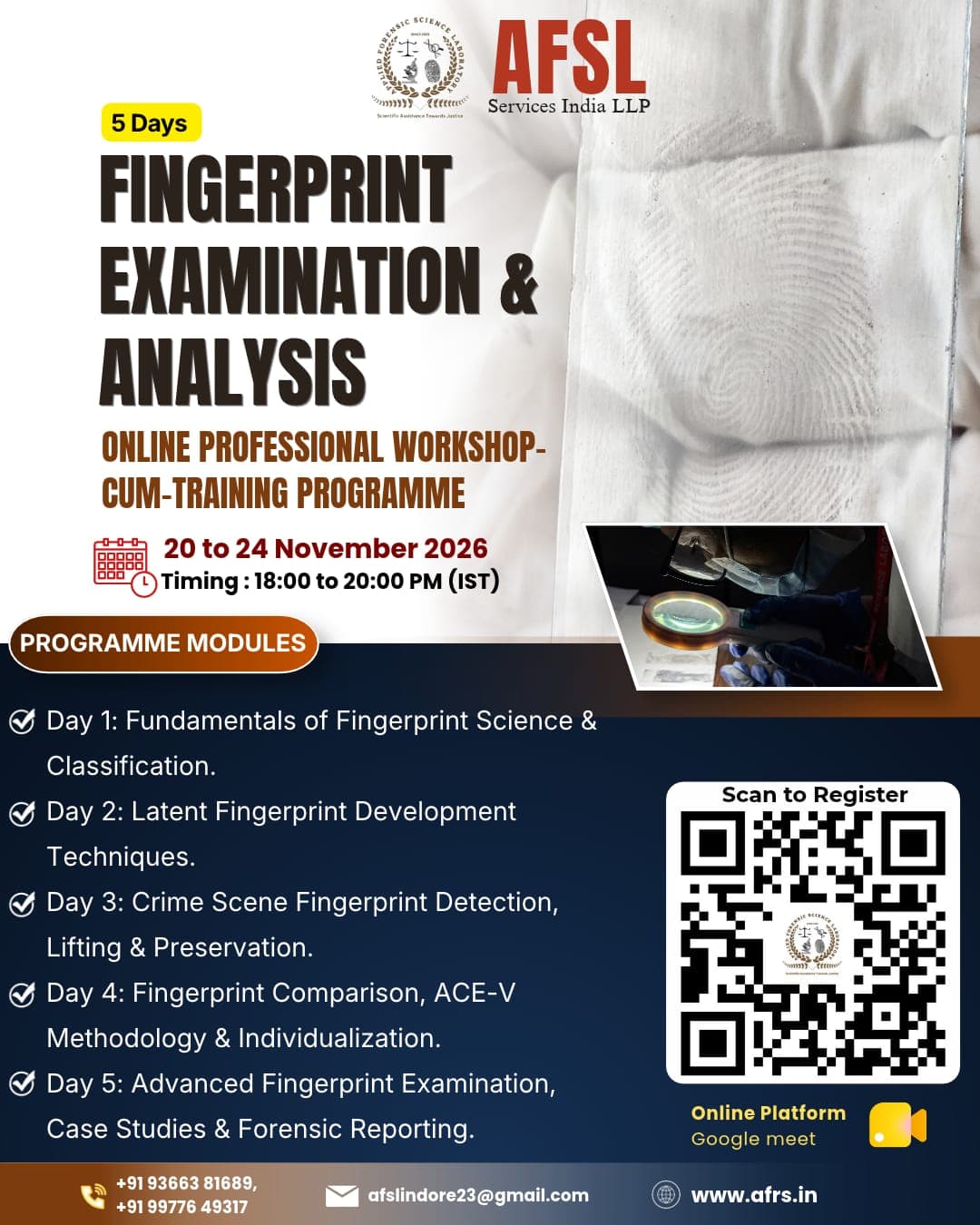
“Explore the Science of Fingerprints – From Detection to Forensic Identification.”
Fingerprints are among the most significant forms of physical evidence encountered during forensic investigations. Their uniqueness, persistence and evidential value make fingerprint examination an essential component of forensic science and criminal investigation.
AFSL Services India LLP presents a 𝟱 𝗗𝗮𝘆𝘀 𝗢𝗻𝗹𝗶𝗻𝗲 𝗣𝗿𝗼𝗳𝗲𝘀𝘀𝗶𝗼𝗻𝗮𝗹 𝗪𝗼𝗿𝗸𝘀𝗵𝗼𝗽-𝗰𝘂𝗺-𝗧𝗿𝗮𝗶𝗻𝗶𝗻𝗴 𝗣𝗿𝗼𝗴𝗿𝗮𝗺𝗺𝗲 𝗼𝗻 𝗙𝗶𝗻𝗴𝗲𝗿𝗽𝗿𝗶𝗻𝘁 𝗘𝘅𝗮𝗺𝗶𝗻𝗮𝘁𝗶𝗼𝗻 & 𝗔𝗻𝗮𝗹𝘆𝘀𝗶𝘀, designed to provide participants with a systematic understanding of the scientific principles, methodologies and practical applications of fingerprint examination.
The programme will cover the fundamental concepts of fingerprint science, pattern classification, ridge characteristics, latent fingerprint development, physical and chemical development techniques, crime scene detection, fingerprint lifting, preservation, documentation and comparison methodologies.
Participants will gain exposure to various fingerprint development techniques, including powder dusting, ninhydrin, silver nitrate and cyanoacrylate fuming through live demonstrations and case studies. The programme will also introduce participants to the ACE-V methodology, minutiae analysis, fingerprint comparison, digital fingerprint examination and Automated Fingerprint Identification Systems (AFIS).
Special emphasis will be placed on evidence handling, documentation, interpretation of examination results, forensic reporting, limitations of fingerprint evidence and courtroom perspectives.
This programme combines theoretical knowledge with demonstration-based learning, interactive discussions and guided analytical exercises to strengthen participants' understanding of professional fingerprint examination practices.
𝐀𝐢𝐦 𝐨𝐟 𝐭𝐡𝐞 𝐖𝐨𝐫𝐤𝐬𝐡𝐨𝐩: The primary aim of this workshop is to develop a comprehensive understanding of fingerprint examination and its practical applications in forensic investigation.
𝐓𝐡𝐞 𝐬𝐩𝐞𝐜𝐢𝐟𝐢𝐜 𝐨𝐛𝐣𝐞𝐜𝐭𝐢𝐯𝐞𝐬 𝐚𝐫𝐞:
- To understand the scientific principles and fundamentals of fingerprint identification.
- To familiarise participants with fingerprint patterns, classification systems and ridge characteristics.
- To introduce various physical and chemical techniques used for latent fingerprint development.
- To understand fingerprint detection, lifting, preservation and documentation procedures.
- To develop an understanding of fingerprint comparison and ACE-V methodology.
- To introduce digital fingerprint analysis and AFIS technology.
- To familiarise participants with forensic examination reports, evidential interpretation and courtroom applications.
- To enhance analytical skills through case studies and guided fingerprint examination exercises.
𝐃𝐚𝐲-𝐰𝐢𝐬𝐞 𝐂𝐮𝐫𝐫𝐢𝐜𝐮𝐥𝐮𝐦
DAY 1: Fundamentals of Fingerprint Science & Classification
DAY 2: Latent Fingerprint Development Techniques
DAY 3: Crime Scene Fingerprint Detection, Lifting & Preservation
DAY 4: Fingerprint Comparison, ACE-V Methodology & Individualization.
DAY 5: Advanced Fingerprint Examination, Case Studies & Forensic Reporting.
𝐖𝐡𝐨 𝐒𝐡𝐨𝐮𝐥𝐝 𝐀𝐭𝐭𝐞𝐧𝐝?
- B.Sc. and M.Sc. Forensic Science Students.
- Students and Researchers from Criminology and Criminal Justice.
- Forensic Science Professionals and Laboratory Personnel.
- Police Officers and Investigation Personnel.
- Law Students, Advocates and Legal Professionals.
- Academicians and Research Scholars.
- Individuals interested in fingerprint science and forensic investigation.
No prior professional experience in fingerprint examination is required. Basic familiarity with forensic science may be helpful.
𝐂𝐞𝐫𝐭𝐢𝐟𝐢𝐜𝐚𝐭𝐞 𝐨𝐟 𝐏𝐚𝐫𝐭𝐢𝐜𝐢𝐩𝐚𝐭𝐢𝐨𝐧: Participants who successfully complete the five-day programme and fulfil the prescribed attendance and assessment requirements will be awarded a Certificate of Participation by AFSL Services India LLP.
Indian participants
International participants
Need Help?
For queries about registration, fees, or certificates, contact our support team.
Contact Support →