


Abstract
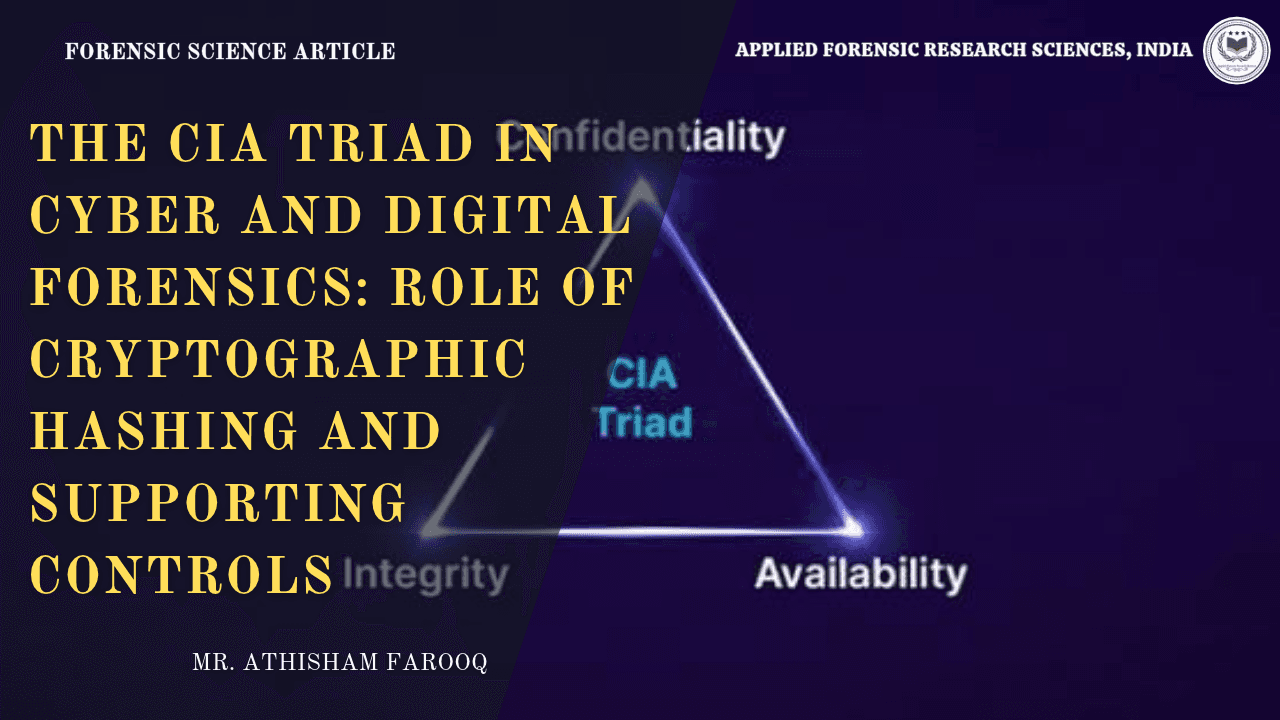
The Confidentiality, Integrity and Availability (CIA) triad is the foundational model of information security. In digital forensics it also governs how evidence is collected, preserved and presented. This article examines each element of the triad, with emphasis on cryptographic hashing as the principal technique for proving evidence integrity, and links these principles to a practical forensic workflow.
1. Introduction
Modern investigations depend on digital artefacts such as disk images, memory dumps, network logs and mobile device extractions. Unlike physical evidence, digital data can be altered by a single command, often without visible trace. Investigators must therefore demonstrate that evidence is protected from disclosure, has not been modified, and remains accessible for analysis and court proceedings. These three requirements correspond directly to the CIA triad.
The triad is used both as a security design model and as a forensic principle. Security teams apply it to reduce risk, while forensic examiners apply it to justify that the evidence they present is authentic and reliable. Understanding both perspectives is essential for anyone working in cyber security or digital forensics.
2. Confidentiality
Confidentiality ensures that information is accessible only to authorised individuals, processes or systems. Loss of confidentiality occurs through data breaches, insider misuse, interception of network traffic or weak access control.
2.1 Technical Controls
Encryption is the primary mechanism for protecting confidentiality. Symmetric algorithms such as the Advanced Encryption Standard (AES) protect data at rest, for example in full-disk encryption products like BitLocker and VeraCrypt. Asymmetric algorithms such as RSA and elliptic curve cryptography support secure key exchange, and protocols such as Transport Layer Security (TLS) protect data in transit. Access control models, including role-based access control, the principle of least privilege and multi-factor authentication, restrict who may view or handle information.
2.2 Forensic Relevance
Confidentiality affects forensics in two ways. First, investigators frequently encounter encrypted devices and must rely on lawful key recovery, memory analysis or credential discovery to obtain access. Second, forensic material itself is sensitive, since it may contain personal, financial or privileged data. Evidence must therefore be stored in access-controlled repositories, and every access must be logged so that the chain of custody remains intact.
3. Integrity
Integrity means that data remains accurate, complete and unaltered except by authorised and recorded actions. For forensic examiners this is the most critical property, because evidence that cannot be shown to be unchanged may be challenged or ruled inadmissible.
3.1 Cryptographic Hash Functions
A cryptographic hash function maps input of any length to a fixed-length digest. Widely used algorithms include MD5 (128-bit), SHA-1 (160-bit) and the SHA-2 family, such as SHA-256 (256-bit), as specified in FIPS 180-4. A suitable hash function must satisfy several properties:
Deterministic output: the same input always produces the same digest. Avalanche effect: a change of even one bit in the input produces a completely different digest. Pre-image resistance: it is computationally infeasible to recover the input from the digest. Collision resistance: it is infeasible to find two different inputs that produce the same digest.
MD5 and SHA-1 are now considered cryptographically weak, since practical collision attacks have been demonstrated against both (Wang and Yu, 2005; Stevens et al., 2017). Current good practice is to compute SHA-256 either alone or alongside a legacy hash, so that older case records remain comparable while stronger assurance is provided.
3.2 Hashing in the Forensic Process
Hashing is applied at several stages of an investigation. During acquisition, the examiner uses a hardware or software write blocker to prevent modification of the source drive, creates a bit-for-bit forensic image, and calculates a hash of both the source and the image. Matching values verify that the copy is exact. The hash is recorded in the case documentation and recalculated before analysis and again before reporting, so any accidental change is detected immediately. A typical command on a Linux workstation is: sha256sum evidence.dd
Hashing is also used for file identification. Examiners compare file hashes against reference collections such as the National Software Reference Library (NSRL) to exclude known operating system files, and against databases of known illicit or malicious files to flag items of interest. This greatly reduces the volume of data requiring manual review. Fuzzy hashing tools such as ssdeep additionally detect files that are similar rather than identical.
3.3 Related Integrity Mechanisms
A plain hash shows that data has not changed but does not identify who produced it. Hash-based Message Authentication Codes (HMAC) add a secret key to provide both integrity and authenticity. Digital signatures combine hashing with asymmetric cryptography, giving integrity, authentication and non-repudiation, and are used to sign forensic reports, software updates and log files. Trusted timestamps and tamper-evident logging further support the reliability of evidence.
4. Availability
Availability guarantees that authorised users can access information and systems when required. Threats include distributed denial-of-service (DDoS) attacks, ransomware, hardware failure, misconfiguration and natural disasters.
4.1 Protective Measures
Availability is maintained through redundancy, such as RAID arrays and clustered servers, regular tested backups, load balancing, patch management and documented disaster recovery plans. Network defences, including rate limiting and traffic filtering, mitigate denial-of-service attacks. The 3-2-1 backup rule, with three copies on two media types and one stored offsite, is a widely adopted guideline.
4.2 Forensic Relevance
In forensics, availability concerns both the compromised system and the evidence. Ransomware incidents demonstrate how attacks on availability can be combined with data theft. Investigators must also preserve evidence so that it remains retrievable for the duration of legal proceedings, which requires suitable storage media, duplicate verified copies and adequate log retention policies. Volatile data such as running processes and network connections is available only while the system is powered on, so it is collected first, following the order of volatility described in NIST SP 800-86.
5. Applying the Triad to a Forensic Workflow
The three principles can be mapped onto a standard investigation. During identification and collection, the examiner isolates the device, documents its state and acquires the image through a write blocker, preserving integrity. During preservation, hashes are recorded, evidence is encrypted and stored with restricted access, and each transfer is logged, supporting confidentiality and chain of custody. During analysis, work is carried out on verified copies rather than originals, which protects the source and keeps it available for independent verification by the opposing party. During reporting, the examiner presents the recorded hash values, tools used and procedures followed so that the findings can be reproduced and tested.
Consider a case in which a suspect laptop is seized. The examiner photographs the scene, connects the drive to a write blocker, images it with a validated tool and records the SHA-256 value. The image is copied to secured storage, the copy is hashed and compared, and the original is sealed. Later, an independent expert receives a duplicate, recalculates the hash and obtains the same value, which confirms that the evidence was not altered between collection and examination.
6.Challenges and Limitations
The triad elements can conflict. Strong encryption improves confidentiality but may hinder lawful access and slow recovery, while extensive redundancy improves availability but enlarges the attack surface. Hashing has its own limits: it detects change but cannot explain it, and outdated algorithms are vulnerable to collisions. Cloud environments, encrypted messaging, anti-forensic tools and very large storage volumes further complicate evidence handling. Organisations must therefore balance the three principles according to risk, legal requirements and operational needs, guided by standards such as ISO/IEC 27001.
Conclusion
The CIA triad provides a practical framework for both protecting information and handling digital evidence. Confidentiality controls limit exposure of sensitive material, availability measures keep systems and evidence accessible, and integrity mechanisms, particularly cryptographic hashing, provide verifiable proof that evidence is authentic. Investigators who apply current hash algorithms, validated tools and documented procedures can present evidence that withstands technical and legal scrutiny. As threats and technologies evolve, the triad remains a dependable basis for both security practice and forensic methodology.
References
[1] National Institute of Standards and Technology (2015). FIPS PUB 180-4: Secure Hash Standard (SHS). U.S. Department of Commerce.
[2] Kent, K., Chevalier, S., Grance, T. and Dang, H. (2006). NIST SP 800-86: Guide to Integrating Forensic Techniques into Incident Response.
[3] Wang, X. and Yu, H. (2005). How to break MD5 and other hash functions. EUROCRYPT 2005, Springer.
[4] Stevens, M., Bursztein, E., Karpman, P., Albertini, A. and Markov, Y. (2017). The first collision for full SHA-1. CRYPTO 2017, Springer.
[5] International Organization for Standardization (2022). ISO/IEC 27001:2022 Information security management systems: Requirements.