


v Program Objective & Overview
The one-month Industrial-Oriented Cybersecurity Training Program was designed to provide comprehensive understanding of cybersecurity practices aligned with industry requirements. Emphasis was placed on identifying cyber threats, analysing vulnerabilities, and implementing security measures to protect digital systems and data. Core areas such as network security, incident response, system protection, and digital forensics were addressed to reflect real-world cybersecurity environments.
The program was structured to integrate theoretical concepts with practical and case-based approaches in order to enhance technical awareness and problem-solving ability. Exposure to industry-relevant tools, security frameworks, and investigative techniques was provided to support effective threat detection and response. The training aimed to strengthen analytical skills, technical competence, and professional readiness required for roles in cybersecurity and digital forensics domains.
· To develop understanding of cybersecurity principles and industry-oriented security practices.
· To explain various cyber threats, vulnerabilities, and risk mitigation strategies.
· To provide knowledge of network security, system protection, and incident response mechanisms.
· To introduce tools and techniques used in cybersecurity and digital forensic investigations.
· To enhance analytical skills and practical awareness for real-world cybersecurity challenges.
v Modules Covered
1. Introduction to Cybersecurity
Fundamental concepts of cybersecurity were explained, including the importance of information security, threat landscape, and basic security principles used to protect digital assets.
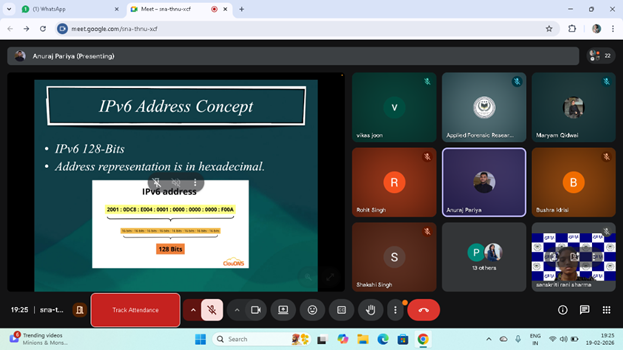
2. Networking Fundamentals
Core networking concepts such as network architecture, protocols, IP addressing, and data transmission were discussed to support understanding of secure communication systems.
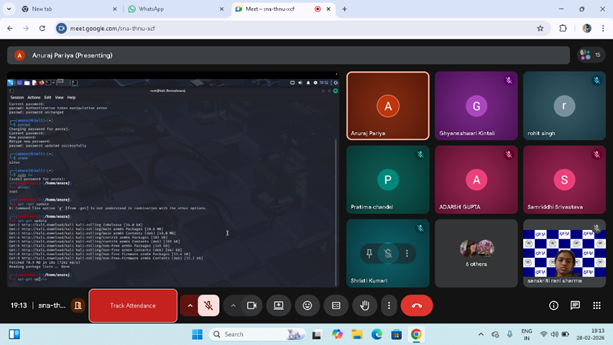
3. Operating Systems and Linux Basics
Basic functioning of operating systems with emphasis on Linux environments was introduced, including command-line operations and system-level security concepts.
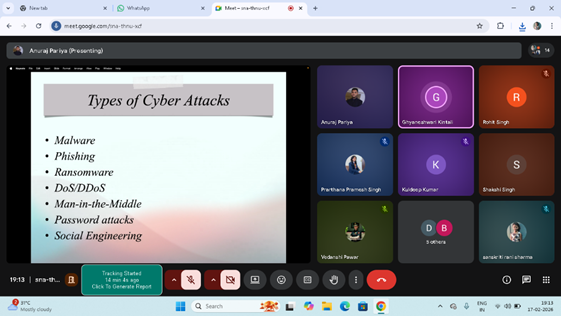
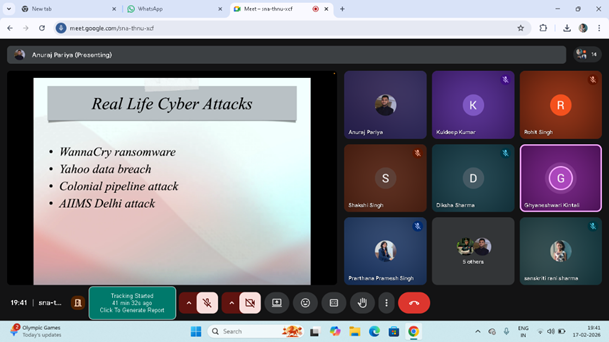
4. Cyber Attacks and Threats
Various types of cyber-attacks, such as malware, phishing, and unauthorized access, were explained along with methods used to identify and mitigate such threats.
5. Web Application Security
Common vulnerabilities in web applications and techniques used to secure web-based systems were addressed, including input validation and secure coding practices.
6. Network and System Security
Measures for protecting networks and computer systems were discussed, including firewalls, intrusion detection systems, and access control mechanisms.
7. Cyber Laws and Career Path
Relevant cyber laws, legal frameworks, and ethical considerations were introduced along with guidance on career opportunities and professional pathways in cybersecurity.
v Practical Exposure
1. Lab Setup and Linux Practice
A virtual lab environment was established, and practical exposure to Linux systems was provided, including basic command-line operations and system navigation.
2. Wireshark
Network traffic analysis was demonstrated using Wireshark to understand packet capture, protocol analysis, and identification of suspicious activities.
3. Nmap
Network scanning techniques were performed using Nmap for host discovery, port scanning, and identification of network vulnerabilities.
4. Burp Suite
Web application security testing was demonstrated using Burp Suite, including modules such as Proxy, Repeater, and Intruder. Techniques like SQL Injection testing and payload analysis were illustrated to understand web vulnerabilities and exploitation methods.
v Resource Persons/Experts
1. Mr. Anuraj Pariya
He is a renowned speaker and a well-versed expert in cybersecurity with a great experience of working with top industrialists and companies, and has a strong foundation in cyber forensics and related disciplines. He has also delivered guest lectures and is very passionate towards the field.
v Participants Details
ü This training activity attracted participants coming from varied educational and working backgrounds connected with questioned document and handwriting examination areas. National and International Participants (B.Sc., M.Sc. Forensic Science Students) and working professionals.
v Learning Outcome
ü Understanding of core cybersecurity principles and industry-oriented practices was developed.
ü The ability to identify and analyse cyber threats, attacks, and system vulnerabilities was enhanced.
ü Knowledge of networking, operating systems, and Linux-based environments was strengthened.
ü Practical skills in using tools such as Wireshark, Nmap, and Burp Suite for security analysis were acquired.
ü Awareness of web application security, network protection, and cyber laws was improved.
ü Analytical and problem-solving skills for real-world cybersecurity scenarios were enhanced.
v Certificate
Completing a one-month training course in the Industrial-Oriented Cybersecurity Training Program earned them a certificate. Certification was provided in both electronic (e-certificate) and hard-copy formats for official and academic purposes.
v Media & Visuals





v Conclusion
The one-month Industrial-Oriented Cybersecurity Training Program successfully provided comprehensive exposure to fundamental and applied aspects of cybersecurity. Key areas such as networking, operating systems, cyber threats, web application security, and legal frameworks were systematically addressed. The inclusion of practical sessions involving lab setup, Linux practice, and tools such as Wireshark, Nmap, and Burp Suite supported an effective understanding of real-world security challenges. Overall, the program contributed to enhancing technical competence, analytical capability, and professional preparedness for roles in cybersecurity and related domains.