


v Program Objective & Overview
The one-month training program on Ballistics and Firearm Examination was designed to provide comprehensive understanding of firearm science and its application in forensic investigations. Emphasis was placed on the classification of firearms, internal, external, and terminal ballistics, and the scientific examination of firearms and ammunition. The principles underlying bullet trajectory, impact analysis, and identification of firearms were addressed to support accurate forensic interpretation.
The program was structured to integrate theoretical knowledge with case-based illustrations related to firearm-related offences. Key aspects such as weapon identification, cartridge examination, gunshot residue analysis, and interpretation of firing patterns were systematically covered. The training aimed to enhance analytical capability, technical awareness, and professional competence required for forensic ballistics examination and crime scene investigation.
· To develop an understanding of the fundamental principles of forensic ballistics
· To explain the classification and functioning of firearms and ammunition
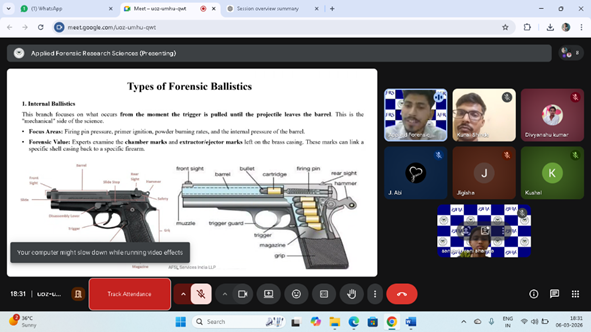
· To provide knowledge of internal, external, and terminal ballistics
· To introduce methods used for firearm and ammunition examination
· To enhance the interpretation of ballistic evidence in criminal investigations
v Modules Covered
1. Introduction to Ballistics
Fundamental concepts of forensic ballistics were explained, including its scope, significance, and application in criminal investigations.
2. Firearms and Their Types
The definition, classification, and functioning of firearms were discussed, including different types such as handguns, rifles, and shotguns, along with their forensic relevance.
3. Bullets and Their Types
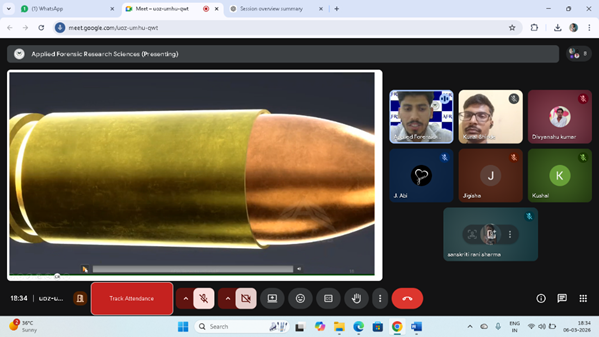
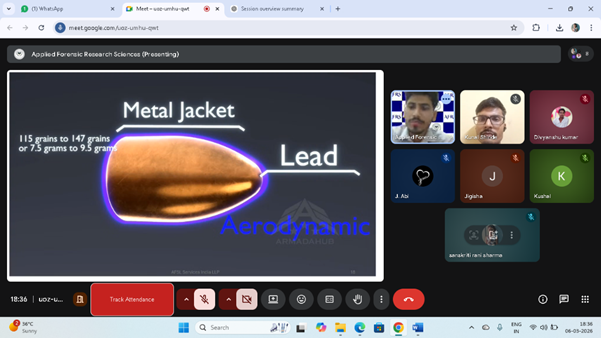
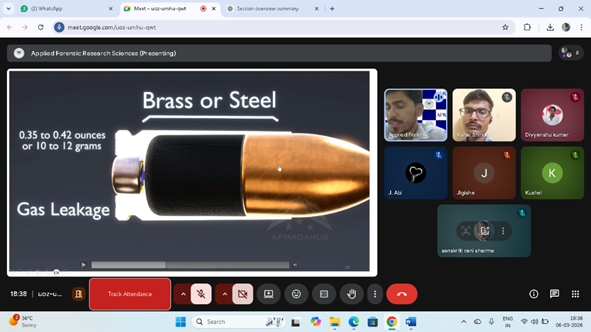
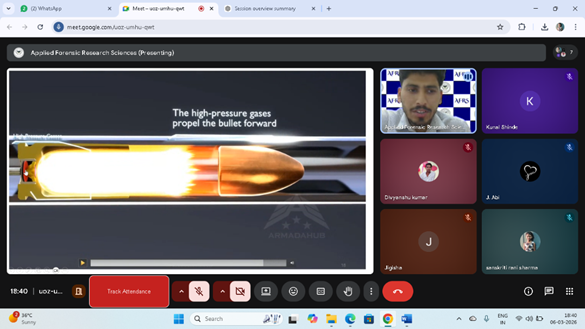
Various types of bullets were described, including their structure, composition, and characteristics, with emphasis on their behaviour during firing and impact.
4. Ammunition Components
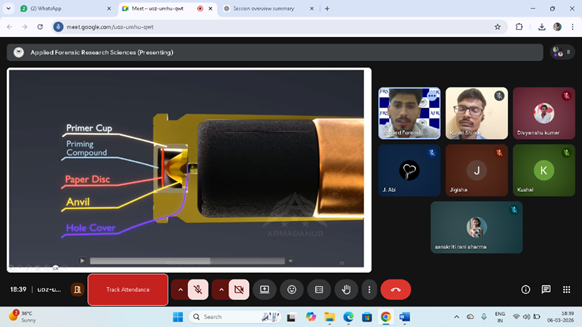
The components of ammunition, such as primers, propellants, and wads, were explained in detail, along with their role in the firing mechanism.
5. Examination of Firearms and Ammunition
Methods used for the forensic examination of firearms, bullets, cartridge cases, and ammunition components were addressed, including identification and comparison techniques.
6. Advancements in Ballistics
Recent developments and modern technologies used in ballistic analysis and firearm identification were introduced to highlight improvements in forensic accuracy and investigation.
v Practical Exposure
Practical exposure was provided through live video demonstrations, case study discussions, and interactive sessions. Real firearm-related cases were analysed to illustrate the application of ballistic examination techniques, including the identification of firearms, bullets, and ammunition components. Interactive discussions supported a better understanding of investigative procedures and the interpretation of ballistic evidence in forensic practice.
v Resource Persons/Experts
1. Mr. Rakesh Mia
He is the Director of the Applied Forensic Science Laboratory. He has completed his master's with a specialisation in Cyber Security & Digital Forensics from the Department of Forensic Science, Jharkhand Raksha Shakti University, Ranchi. He has published various papers and abstracts in national, international, and Scopus-indexed journals and conferences. He has organised more than 400+ National and International Conferences, Workshops, etc. in A.F.R.S. He has written 2 edited books, 2 chapters, and 2 research paper proceedings books. Also, he has received 4 copyright certificates from the Central Government of India. He received the certificate of excellence on Republic Day, 26th Jan 2023, for chapter writing. He also trained more than 4000+ Forensic national and international students, professionals, advocates, etc. He is the founder and president of Applied Forensic Research Sciences. Also, he is the founder of India's first virtual National Museum of Forensic Science.
2. Mr. Vijay Panchal
He is Vice President, Applied Forensic Research Sciences, Indore (MP). He has completed his PG Diploma in Crime Scene Photography from the National Forensic Sciences University, Delhi Campus, Ministry of Home Affairs, Government of India. He has completed his master's with a specialisation in Forensic Physics and Ballistics from the Department of Forensic Science, Jharkhand Raksha Shakti University, Ranchi. He has published many papers, abstracts in national and international journals and conferences. Recently, he has written 3 books, one is Handbook of Basic Forensic Science in both the English & Hindi languages, and the other one is Handbook of Forensic Biology & Forensic Serology and recently Textbook of Forensic Fingerprinting- A Practical Approach in Criminal Justice System. He has also written 2 chapters in a book, titled "Role of Nanotechnology in Forensic Analysis' & "Recent Biotechnology Tools and Techniques in Forensic Science In the edited book titled 'Advanced Forensic Biotechnology (Volume 2)". Also, he has received 3 copyright certificates from the Central Government of India. He received the certificate of excellence on Republic Day, 26th Jan 2023, for chapter writing. He has been awarded the 100 Rising Author and Educationist Nation Choice Awards by Grantor X Nation Choice Award. He has been working as a Co-Founder & Vice-President of Applied Forensic Research Sciences. Also, he is fond of India’s first virtual National Museum of Forensic Science.
v Participants Details
ü This training activity attracted participants coming from varied educational and working backgrounds connected with questioned document and fingerprint examination areas. National and International Participants (B.Sc., M.Sc. Forensic Science Students) and working professionals.
v Learning Outcome
ü An understanding of fundamental principles of forensic ballistics was developed.
ü Knowledge of firearms, bullets, and ammunition components and their functioning was enhanced.
ü The ability to identify and interpret ballistic evidence in criminal investigations was strengthened.
ü Awareness of methods used for examination and comparison of firearms and ammunition was improved.
ü Familiarity with recent advancements and technologies in ballistic analysis was gained.
ü Practical insight into real case applications through discussions and visual demonstrations was achieved.
v Certificate
Completing a one-month training course in Forensic Ballistics and Firearm Examination earned them a certificate. Certification was provided in both electronic (e-certificate) and hard-copy formats for official and academic purposes.
v Media & Visuals
v Conclusion
The one-month training program on Ballistics effectively provided structured knowledge on the scientific principles and forensic significance of firearm examination. Key aspects such as classification of firearms, types of bullets and ammunition, and methods of ballistic analysis were systematically addressed. The inclusion of live video demonstrations, case study discussions, and interactive sessions supported a better understanding of practical applications in forensic investigations. Overall, the program contributed to enhancing technical awareness, analytical skills, and professional competence required for the examination and interpretation of ballistic evidence.