


v Program Objective & Overview
The one-month training program on Crime Scene Investigation and Management was designed to provide comprehensive understanding of systematic procedures involved in handling and investigating crime scenes. Emphasis was placed on recognition, documentation, collection, preservation, and management of physical evidence in accordance with forensic and legal standards. The importance of maintaining scene integrity and chain of custody was highlighted to ensure admissibility of evidence in judicial proceedings.
The program was structured to integrate theoretical concepts with case-based illustrations to support accurate and efficient crime scene processing. Key aspects such as scene security, evidence handling protocols, forensic documentation, and coordination among investigative personnel were addressed. The training aimed to enhance observational skills, procedural accuracy, and professional competence required for effective crime scene investigation.
· To develop an understanding of the principles and procedures of crime scene management
· To explain methods of evidence recognition, collection, and preservation
· To emphasise the importance of scene security and the chain of custody
· To provide knowledge of documentation techniques, including photography and report writing
· To enhance analytical and observational skills required for crime scene investigation
v Modules Covered
1. Introduction to Crime Scene Management
Fundamental concepts of crime scene management were explained, including its scope, importance, and role in forensic investigations.
2. Procedures in Crime Scene Management
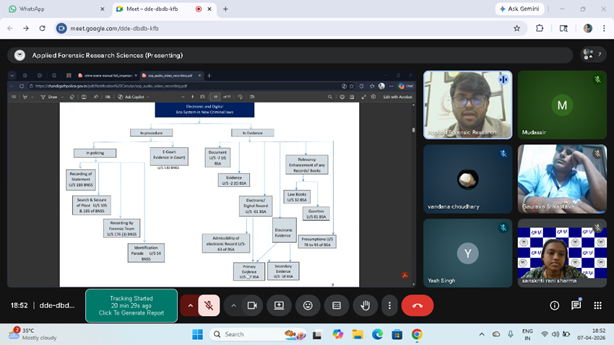
Systematic procedures for securing, assessing, documenting, and processing a crime scene were discussed to ensure proper investigation and evidence handling.
3. Collection and Preservation of Evidence
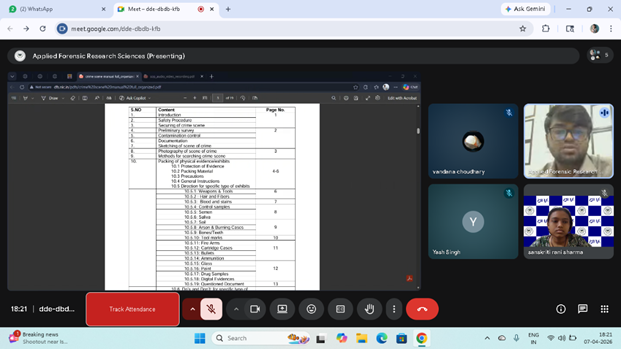
Methods for the identification, collection, packaging, and preservation of physical evidence were addressed to maintain integrity and prevent contamination.
4. Different Methods Used in Crime Scene Investigation
Various approaches for searching, documenting, and reconstructing crime scenes were explained to support accurate evidence recovery.
5. Traditional Methods of Crime Scene Processing
Conventional techniques such as manual documentation, sketching, and basic evidence collection methods were discussed.
6. Advanced Methods in Crime Scene Management
Modern technologies and advancements, including digital documentation, 3D reconstruction, and improved forensic tools, were introduced.
7. Body Farms and Their Role
The concept of body farms was explained with emphasis on their use in studying decomposition and improving crime scene investigation techniques.
v Practical Exposure
ü Mock Crime Scene Demonstration
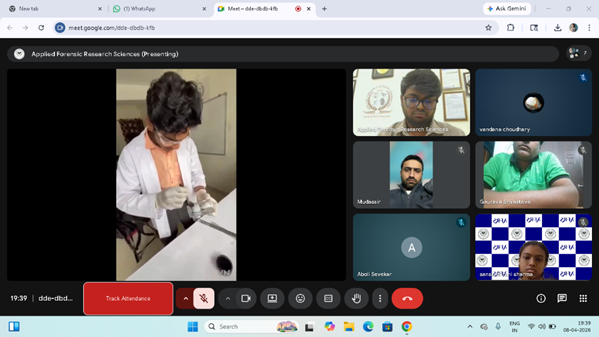
Practical exposure was provided through mock crime scene simulations, where procedures for securing, documenting, and processing the scene were demonstrated through images.
ü Fingerprint Development Techniques
Live demonstrations of fingerprint development methods were conducted to illustrate the visualization of latent prints on different surfaces.
ü Fingerprint Lifting and Preservation
Techniques for lifting developed fingerprints and their proper preservation were demonstrated to maintain evidentiary integrity.
ü Advanced Techniques (Crime-lite Auto, FERO, Forenscope)
Advanced tools and techniques such as Crime-lite Auto, FERO techniques, and Forenscope were demonstrated to highlight modern methods used for enhanced detection and examination of forensic evidence.
ü Evidence Collection and Case Study Discussion
Methods of evidence collection were illustrated, and live case study discussions were conducted to support understanding of real-world crime scene investigation and evidence interpretation.
v Resource Persons/Experts
1. Mr. Rakesh Mia
He is the Director of the Applied Forensic Science Laboratory. He has completed his master's with a specialisation in Cyber Security & Digital Forensics from the Department of Forensic Science, Jharkhand Raksha Shakti University, Ranchi. He has published various papers and abstracts in national, international, and Scopus-indexed journals and conferences. He has organised more than 400+ National and International Conferences, Workshops, etc. in A.F.R.S. He has written 2 edited books, 2 chapters, and 2 research-proceedings books. He has also received 4 copyright certificates from the Central Government of India. He received the certificate of excellence on Republic Day, 26th Jan 2023, for chapter writing. He also trained more than 4000+ Forensic national and international students, professionals, advocates, etc. He is the founder and president of Applied Forensic Research Sciences. Also, he is the founder of India's first virtual National Museum of Forensic Science.
v Participants Details
ü This training activity attracted participants coming from varied educational and working backgrounds connected with questioned document and fingerprint examination areas. National and International Participants (B.Sc., M.Sc. Forensic Science Students) and working professionals.
v Learning Outcome
ü An understanding of principles and procedures of crime scene management was developed.
ü The ability to recognise, collect, and preserve physical evidence was enhanced.
ü Knowledge of crime scene documentation methods and reconstruction techniques was strengthened.
ü Awareness of traditional and advanced methods used in crime scene investigation was improved.
ü Practical insight into mock as well as real crime scene handling and real case analysis was gained
v Certificate
Completing a one-month training course in Crime Scene Investigation and Management earned them a certificate. Certification was provided in both electronic (e-certificate) and hard-copy formats for official and academic purposes.
v Media & Visuals

v Testimonial

v Conclusion
The one-month training program on Crime Scene Investigation and Management effectively provided structured knowledge on the procedures and practices involved in crime scene investigation. Key aspects such as scene security, evidence recognition, collection, preservation, and documentation were systematically addressed. The inclusion of mock crime scene simulations, evidence collection demonstrations, and live case study discussions supported a better understanding of practical applications. Overall, the program contributed to enhancing observational skills, procedural accuracy, and professional competence required for effective crime scene management and forensic investigation.