


v Program Objective & Overview
The one-month training program on Fingerprint Examination and Analysis was designed to provide a comprehensive understanding of fingerprint science and its significance in forensic identification. Emphasis was placed on the principles of fingerprint formation, classification, development, and comparison used in criminal investigations. The scientific basis of fingerprint individuality and permanence was discussed to highlight its evidentiary value in establishing identity.
The program was structured to integrate theoretical concepts with case-based explanations of fingerprint examination and crime scene investigation. Various methods used for development, lifting, and analysis of latent fingerprints were addressed. The training aimed to enhance the analytical understanding and technical awareness needed to interpret fingerprint evidence in forensic practice accurately.
· To develop an understanding of the scientific principles of fingerprint identification
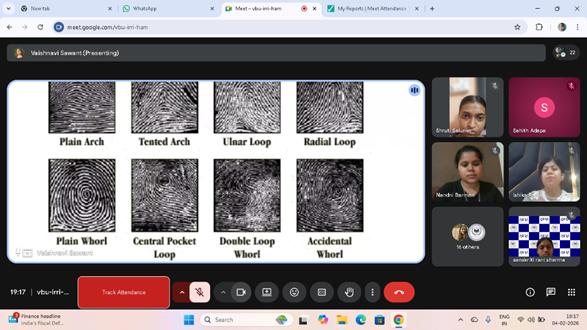
· To explain fingerprint patterns, classification systems, and their forensic significance
· To introduce techniques used for the development, lifting, and preservation of latent fingerprints
· To enhance understanding of fingerprint comparison and analysis in criminal investigations
· To create awareness of modern advancements and technologies used in fingerprint examination
v Modules Covered
1. Introduction to Fingerprint Science and Examination
Fundamental principles of fingerprint science were discussed, including the formation, uniqueness, and permanence of fingerprints. The role of fingerprints in personal identification and criminal investigations was explained.
2. Types of Fingerprints and Development Methods
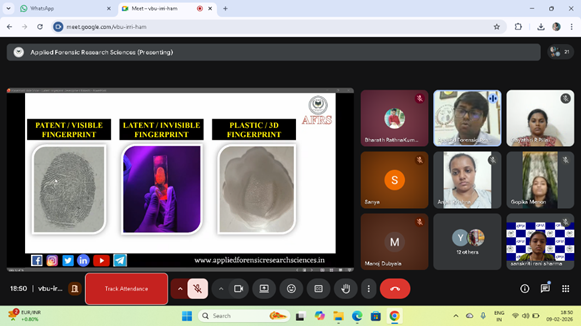
Different types of fingerprints, such as latent, patent, and plastic prints, were described. Various physical and chemical methods for developing latent fingerprints on different surfaces were discussed.
3. Collection and Preservation of Fingerprint Evidence
Standard procedures for locating, lifting, packaging, and preserving fingerprint evidence were explained to prevent contamination and maintain evidentiary value.
4. Fingerprint Analysis and Comparison Methods
Techniques for examining, comparing, and interpreting fingerprint patterns and ridge characteristics were discussed in the context of forensic identification.
5. Advancements in Tools and Techniques
Modern technologies and advanced tools used in fingerprint examination and automated identification systems were introduced to highlight their role in improving forensic accuracy.
6. Report Writing in Fingerprint Cases
The principles of forensic report writing were addressed, including proper documentation, interpretation of findings, and preparation of clear and legally admissible fingerprint examination reports.
v Practical Exposure
Practical exposure was provided through live video demonstrations and discussions of real case study experiences related to fingerprint examination. Various procedures involved in fingerprint development, collection, and analysis were illustrated through visual presentations. These demonstrations supported a better understanding of practical applications and the role of fingerprint evidence in forensic investigations.
v Resource Persons/Experts
1. Mr. Rakesh Mia
He is the Director of the Applied Forensic Science Laboratory. He has completed his master's with a specialisation in Cyber Security & Digital Forensics from the Department of Forensic Science, Jharkhand Raksha Shakti University, Ranchi. He has published various papers and abstracts in national, international, and Scopus-indexed journals and conferences. He has organised more than 400+ National and International Conferences, Workshops, etc. in A.F.R.S. He has written 2 edited books, 2 chapters, and 2 research paper proceedings books. Also, he has received 4 copyright certificates from the Central Government of India. He received the certificate of excellence on Republic Day, 26th Jan 2023, for chapter writing. He also trained more than 4000+ Forensic national and international students, professionals, advocates, etc. He is the founder and president of Applied Forensic Research Sciences. Also, he is the founder of India's first virtual National Museum of Forensic Science.
2. Ms. Vaishnavi Sawant
She is an accomplished Assistant Professor at the Acharya Institute of Graduate Studies, specialising in Criminology and Forensic Science. With a strong academic background and a keen interest in forensic investigations, Ma’am has built a solid foundation in both theoretical and applied aspects of forensic science. Ma’am completed her Bachelor’s degree in Chemistry from Goa University, which laid the groundwork for her scientific approach to forensic analysis. Driven by her passion for crime investigation and forensic studies, Ma’am pursued her postgraduate degree in Criminology and Forensic Science from Mangalore University. During her postgraduation, Ma’am specialized in Questioned Documents and Impression Evidence, developing expertise in handwriting analysis, forged document examination, and related forensic techniques. In addition to her forensic qualifications, Ma’am has completed an advanced course in computer applications in Goa, enabling her to effectively integrate technology into forensic analysis and education. Originally from Goa, India, Ma’am brings a multidisciplinary and analytical perspective to her teaching and research. Through her role as an educator, Ma’am continues to guide and inspire aspiring forensic professionals, contributing meaningfully to the academic and practical advancement of criminology and forensic science.
v Participants Details
ü This training activity attracted participants coming from varied educational and working backgrounds connected with questioned document and fingerprint examination areas. National and International Participants (B.Sc., M.Sc. Forensic Science Students) and working professionals.
v Learning Outcome
ü An understanding of the scientific principles of fingerprint identification was developed.
ü The ability to recognise different types of fingerprints and development methods was enhanced.
ü Knowledge of proper collection, preservation, and handling of fingerprint evidence was strengthened.
ü Awareness of fingerprint analysis and comparison techniques used in forensic investigations was improved.
ü Familiarity with modern tools, techniques, and report writing practices in fingerprint examination was gained.
v Certificate
Completing a one-month training course in Fingerprint Examination and Analysis earned them a certificate. Certification was provided in both electronic (e-certificate) and hard-copy formats for official and academic purposes.
v Media & Visuals



v Testimonial


v Conclusion
The one-month training program on Fingerprint Examination and Analysis provided structured knowledge on the scientific principles and forensic significance of fingerprint evidence. Key aspects such as fingerprint types, development methods, collection, preservation, and analytical procedures were systematically addressed. The inclusion of live video demonstrations and real case study discussions supported better understanding of practical applications in forensic investigations. Overall, the program contributed to enhancing technical awareness and analytical competence required for accurate examination and interpretation of fingerprint evidence in forensic practice.