


v Program Objective & Overview
The seminar on “Fire and Arson Scene Investigation” was organized to provide participants with scientific and practical insights into the investigation of fire-related incidents. The session was delivered by Mr. Durga Prasad Gangwar, Head of Physics at the Central Forensic Science Laboratory (CFSL), Chandigarh. With nearly three decades of analytical experience in forensic science, the speaker offered an in-depth understanding of fire dynamics, causes of fire, and systematic approaches to fire scene examination. The objective of the seminar was to strengthen the scientific understanding of fire behavior and its forensic interpretation in criminal and accidental fire cases.
v Modules Covered
1. Fundamental concepts of fire, including its definition, classification, and underlying scientific principles.
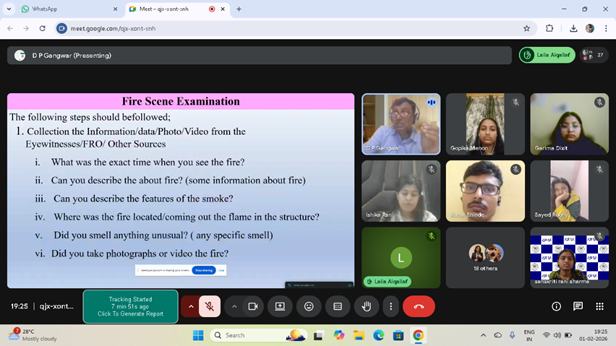
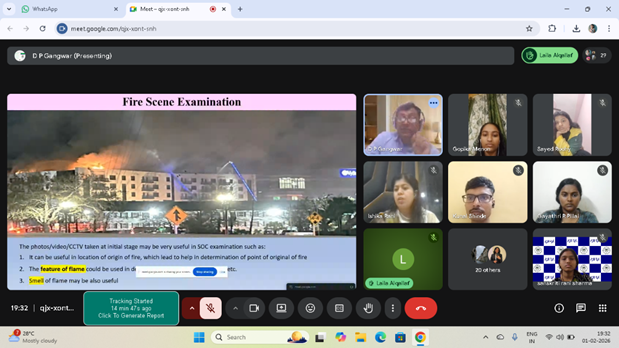
2. Determination of the origin and cause of fire through systematic examination of fire patterns, flame (tongue) configurations, smoke movement, and burn indicators.
3. Detailed analysis of fire patterns, smoke deposition characteristics, electrical short-circuit–induced fires, and the forensic differentiation between accidental and deliberate (incendiary) fires.
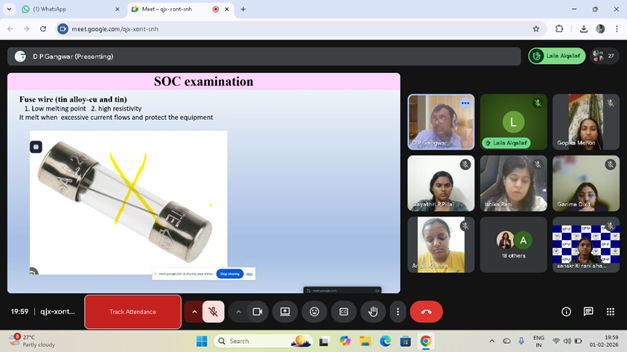
4. Discussion of the physical and mathematical principles governing electrically induced fires, including relevant equations, electrical energy concepts, heat generation mechanisms, and fault analysis.
v Practical Exposure
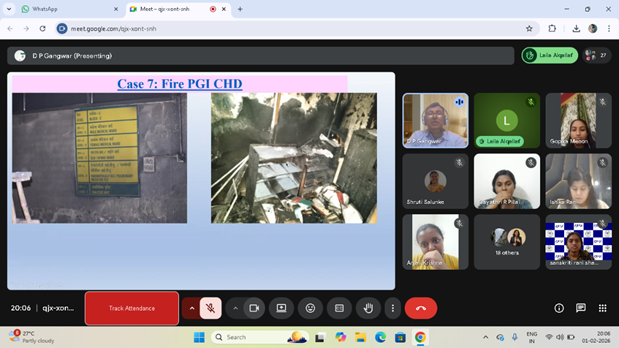
I. Practical exposure was provided through detailed discussion of real-life forensic case studies investigated by the resource person.
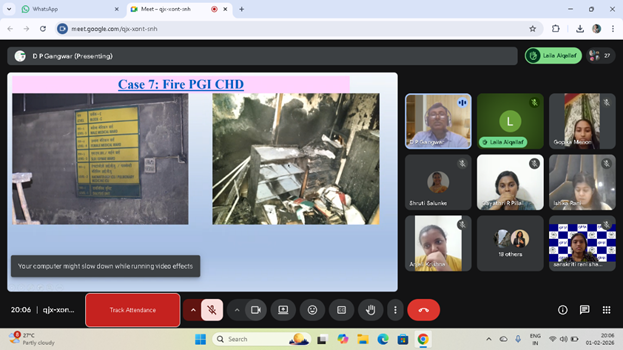
II. Notable cases included the Toyota Chandigarh showroom fire case and a Chandigarh District Court fire incident attributed to an electrical short circuit.
III. Systematic methodologies for the determination of fire origin were demonstrated, including analysis of burn patterns, assessment of heat and smoke effects, and interpretation of electrical evidence.
IV. The case-based discussions highlighted practical challenges encountered in fire and arson scene investigations and emphasised the necessity of scientific reasoning, technical expertise, and methodical evidence evaluation.
v Resource Persons/Experts
§ Mr. Durga Prasad Gangwar
He has 33 years of Analytical experience in the field of Forensic Analysis of different kinds of crime case exhibits, such as Audio and Video, hard disk, memory cards, mobile phones, in Computer Forensic, Mobile Forensic, Soil, Paint, Glass, Building Material, and vehicle accident. Till now, he has delivered approximately 1300 lectures to various trainees all over India and served as Guest Faculty at Panjab University, Chandigarh. He did a master’s in Physics with specialisation in Electronics and a bachelor’s in Physics, Chemistry and Mathematics. He has attended numerous Trainings, Workshops, Seminars and Conferences at the university, national, and international level. He has also published numerous research papers in various National and International journals. Also, he has written a book on "Forensic Evidence-Identification, Collection, Preservation" published in 2023.
v Participants Details
ü This training activity attracted participants coming from varied educational and working backgrounds connected with questioned document and fingerprint examination areas. National and International Participants (B.Sc., M.Sc. Forensic Science Students) and working professionals.
v Learning Outcome
ü Strengthened understanding of fire behaviour and forensic fire investigation techniques.
ü Ability to identify fire origin and cause through analysis of fire patterns and smoke characteristics.
ü Application of scientific methodology and physics-based principles in electrical fire cases.
v Media & Visuals
v Conclusion
The seminar on Fire and Arson Scene Investigation was highly informative and enriching. Mr. Durga Prasad Gangwar demonstrated exceptional subject knowledge and practical experience, effectively connecting theoretical physics with real-world forensic applications. The session provided valuable insights into fire investigation procedures and reinforced the importance of scientific principles in forensic examinations. Overall, the seminar significantly contributed to enhancing the participants’ understanding of fire and arson investigations in forensic science.