


v Program Objective & Overview
The one-month training program on Forensic Medicine and Toxicology was structured to impart comprehensive knowledge of medico-legal principles associated with injury analysis, death investigation, and toxicological evaluation. The program was designed to strengthen the understanding of the interface between medical science and law, ensuring accurate interpretation and documentation of medico-legal findings in judicial contexts.
Emphasis was placed on forensic pathology, clinical forensic medicine, and toxicology through systematic theoretical discussions and case-based illustrations. The training aimed to enhance analytical capability, diagnostic precision, and professional preparedness required for effective medico-legal practice and forensic investigations.
· To develop a clear understanding of medico-legal principles in forensic medicine and toxicology
· To explain injury examination, autopsy procedures, and interpretation of post-mortem findings
· To facilitate determination of cause and manner of death in medico-legal cases
· To introduce principles of forensic toxicology, including identification and effects of poisons
· To strengthen awareness of legal, ethical, and documentation standards in medico-legal practice
v Modules Covered
1. Death and Its Causes
The concept of death was explained with reference to its medico-legal classification, including natural, unnatural, and suspicious deaths. The physiological and pathological mechanisms leading to death were discussed to support accurate cause-of-death determination.
2. Autopsy and Post-Mortem Examination
The objectives, types, and systematic procedures of medico-legal autopsy were described. Emphasis was placed on external and internal examination, documentation of findings, and interpretation of post-mortem changes in relation to time since death.
3. Medico-Legal Cases and Ethical Considerations
Procedures for handling medico-legal cases were addressed along with legal responsibilities, ethical obligations, consent, confidentiality, and professional conduct expected in forensic medical practice.
4. Forensic Entomology
The application of insect evidence in death investigations was discussed, with focus on estimation of post-mortem interval, insect succession, and environmental influences affecting entomological findings.
5. Thermal Injuries
Various forms of thermal injuries, including burns and heat-related trauma, were examined. The medico-legal interpretation of burn patterns, degrees of burns, and cause of death in thermal injuries was explained.
6. Examination of Survivor
The examination of survivors in medico-legal cases was discussed with a focus on clinical assessment, injury documentation, and legal procedures. Emphasis was placed on informed consent, ethical conduct, and preservation of medico-legal evidence, particularly in cases involving assault or trauma.
v Practical Exposure
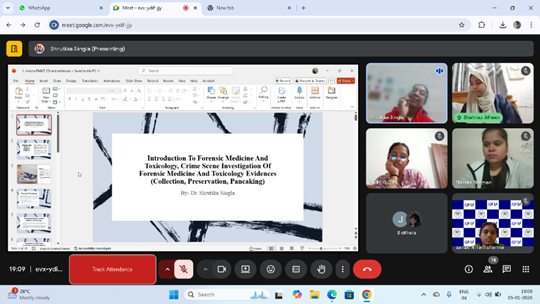
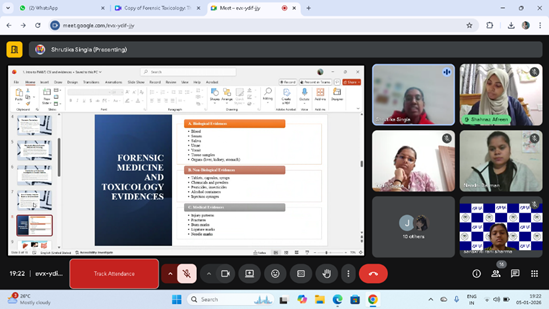
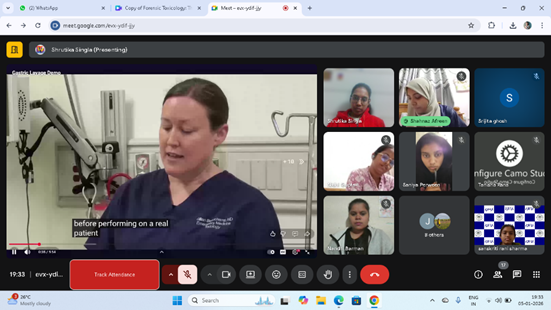
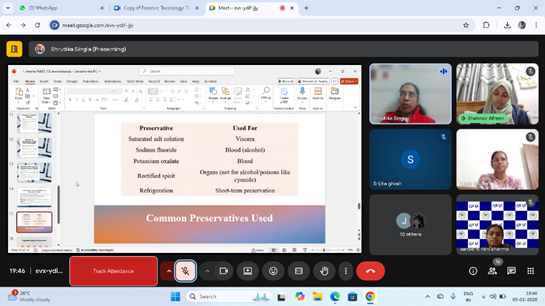
Practical exposure was provided through demonstration of live case experiences and case-related photographs. Real medico-legal scenarios were discussed to illustrate examination procedures, injury interpretation, and documentation practices, supporting a better understanding of practical applications in forensic medicine.
v Resource Persons/Experts
1. Dr. Prasanna Parthasarathy
He is working as a Senior Assistant Professor in the Department of Forensic Medicine in Government Kilpauk Medical College, Chennai. He completed an MD in Forensic Medicine in 2015 and is working for the past 10 years.
2. Dr. Shrutika Singla
She is serving as the Joint Secretary of Applied Forensic Research Sciences and is currently working as an assistant professor at the College of Traffic Management and Forensic Science, Faridabad (affiliated to NFSU). She has also served as a Research Teaching Associate at Amity Institute of Forensic Sciences, Amity University, Noida, for around 2 years. She has completed her PhD in Forensic Science from Amity Institute of Forensic Sciences, Amity University Uttar Pradesh, Noida, India. Her doctoral research focused on the development and validation of advanced analytical and bioanalytical methods for the detection and quantification of anticonvulsant drugs in biological matrices using modern extraction techniques and LC-MS/MS analysis. She has authored and co-authored several research papers and book chapters with reputed international publishers, including Elsevier, Springer, Wiley and CRC Press, contributing to diverse areas such as forensic toxicology, analytical chemistry, environmental forensics and machine learning applications in forensic science.
v Participants Details
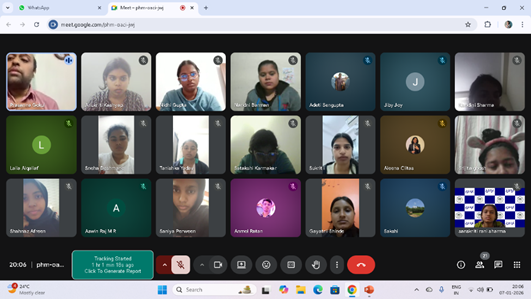
ü This training activity attracted participants coming from varied educational and working backgrounds connected with questioned document and fingerprint examination areas. National and International Participants (B.Sc., M.Sc. Forensic Science Students) and working professionals.
v Learning Outcome
ü A clear understanding of medico-legal principles in forensic medicine and toxicology was developed.
ü The ability to interpret injuries, post-mortem findings, and the cause of death was strengthened.
ü Knowledge of autopsy procedures and post-mortem documentation was enhanced.
ü Awareness of ethical responsibilities and legal requirements in medico-legal cases was improved.
ü Practical insight into real case scenarios through demonstrations and visual evidence was gained.
v Certificate
Completing a one-month training course in Forensic Medicine and Toxicology earned them a certificate. Certification was provided in both electronic (e-certificate) and hard-copy formats for official and academic purposes.
v Media & Visuals
v Conclusion
The one-month training program on Forensic Medicine and Toxicology effectively fulfilled its objectives by providing structured theoretical knowledge and practical insight into medico-legal practice. Key areas such as death investigation, autopsy procedures, injury interpretation, and toxicological principles were systematically addressed in accordance with legal and ethical standards. The inclusion of live case experiences and visual demonstrations strengthened practical understanding and evidentiary interpretation. Overall, the program contributed significantly to enhancing analytical competence, professional awareness, and preparedness for medico-legal responsibilities in forensic practice.