v Program Objective & Overview
The Forensic Nursing Training Programme was designed to provide participants with an understanding of the integration of nursing practice and forensic science in the examination, documentation, and management of patients involved in medico-legal cases. The programme focused on the role of forensic nursing in identifying, collecting, preserving, and documenting physical and biological evidence while ensuring appropriate patient care and maintaining professional and ethical standards.
The training covered key areas such as forensic nursing principles, injury assessment, sexual assault examination, evidence collection and preservation, documentation of medico-legal cases, and the role of forensic nurses in legal proceedings. Emphasis was placed on understanding the responsibilities of healthcare professionals in handling sensitive cases, maintaining confidentiality, preserving evidence integrity, and supporting the justice system through accurate medical documentation.
· To develop an understanding of the fundamentals of forensic nursing and its significance in healthcare and criminal investigations.
· To familiarise participants with the role and responsibilities of forensic nurses in the examination and management of medico-legal cases.
· To explain the principles of injury identification, assessment, documentation, and interpretation in forensic contexts.
· To introduce appropriate procedures for the identification, collection, preservation, and handling of biological and physical evidence.
· To enhance awareness of forensic nursing procedures in cases involving sexual assault, domestic violence, child abuse, and other forms of interpersonal violence.
· To emphasise the importance of accurate medical documentation, confidentiality, patient consent, and ethical practices during forensic examinations.
· To familiarise participants with the role of forensic nurses in providing expert testimony and assisting legal authorities through reliable medico-legal documentation.
· To strengthen understanding of the relationship between clinical nursing practice, forensic investigation, and the administration of justice.
v Modules Covered
1. Introduction to Forensic Nursing – Overview of forensic nursing, its scope, significance, and role in healthcare, forensic investigations, and the justice system.
2. Medico-Legal Nursing & Documentation – Principles of medico-legal nursing, maintenance of medical records, preparation of medico-legal reports, and accurate documentation of clinical findings.
3. Forensic Evidence Collection & Preservation – Procedures for identifying, collecting, packaging, labelling, and preserving biological and physical evidence while maintaining evidence integrity.
4. Injury Assessment & Documentation – Identification, classification, assessment, and systematic documentation of injuries, wounds, and other physical findings relevant to forensic examinations.
5. Sexual Assault & Forensic Examination – Overview of forensic examination procedures in sexual assault cases, evidence collection, patient consent, confidentiality, and sensitive, victim-centred care.
6. Child Abuse & Domestic Violence – Recognition of physical and behavioural indicators of abuse, documentation of findings, safeguarding measures, and medico-legal responsibilities.
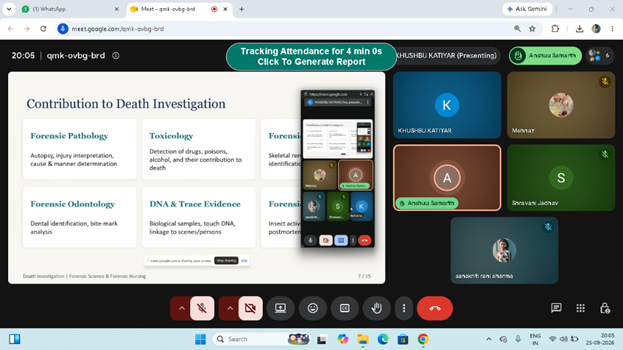
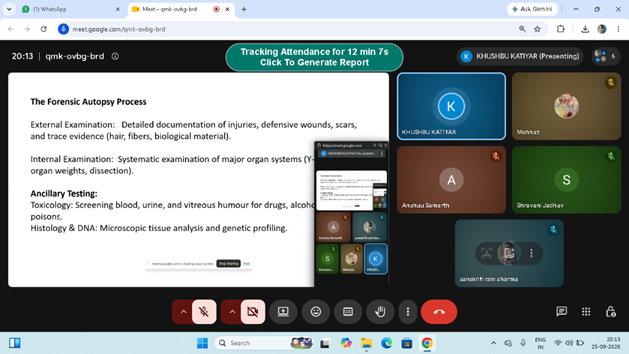
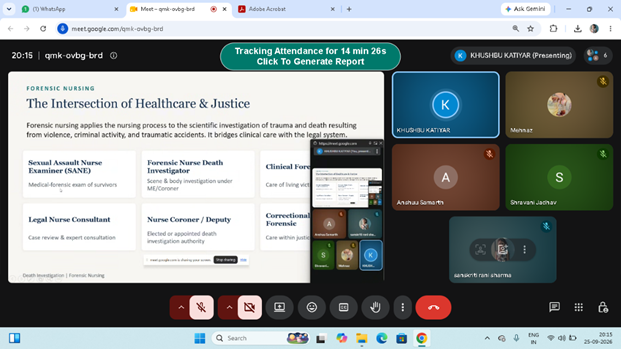
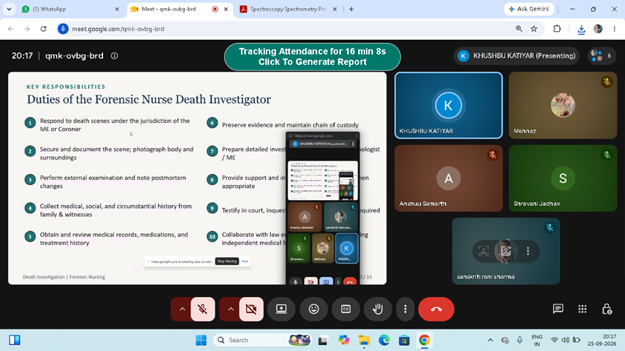
7. Death Investigation – Introduction to the role of forensic nursing in death-related cases, recognition and documentation of relevant findings, and coordination with medico-legal authorities.
8. Forensic Photography & Evidence Documentation – Principles of photographic documentation of injuries and physical evidence, including appropriate lighting, angles, scales, and systematic record-keeping.
9. Chain of Custody & Legal Aspects – Procedures for maintaining a documented chain of custody, ensuring evidence integrity, understanding legal responsibilities, and following ethical and professional standards.
10. Courtroom Testimony & Expert Witness Role – Understanding the responsibilities of forensic nursing professionals in legal proceedings, presentation of medico-legal documentation, and provision of clear, objective testimony when required.
v Practical Exposure
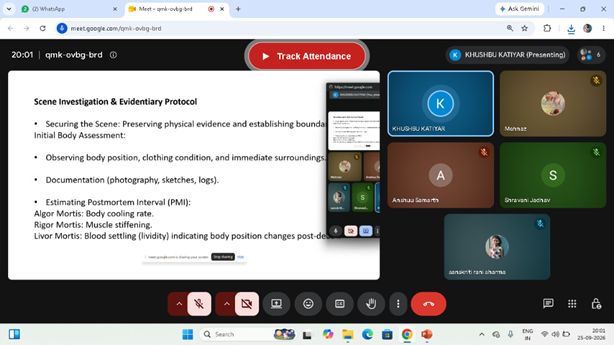
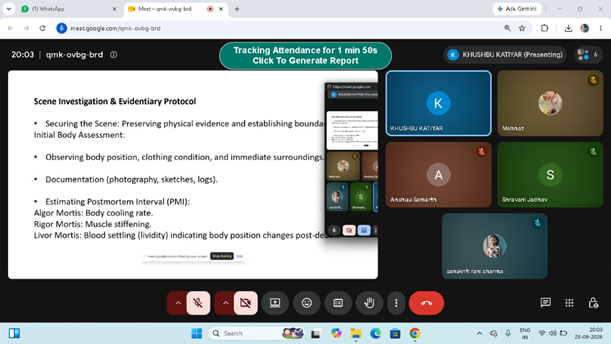
1. Live Case Study Discussions: Real-life case studies related to forensic nursing and medico-legal examinations were discussed to understand the role of nursing professionals in evidence documentation, injury assessment, and forensic investigations.
2. Medico-Legal Report Writing: Guidance was provided on preparing structured medico-legal reports, documenting clinical findings, recording injuries, and maintaining accurate and objective medical records.
3. Forensic Evidence Documentation: The importance of systematic documentation of physical findings, biological evidence, and relevant case details was explained in the context of forensic nursing practice.
4. Case-Based Analysis: Practical discussions were conducted on scenarios involving sexual assault, child abuse, domestic violence, and death investigation to understand the responsibilities of forensic nursing professionals.
5. Assessment and Evaluation: Participants' understanding of the topics covered was assessed through case-based questions and evaluation activities to reinforce conceptual knowledge and assess learning outcomes.
v Resource Persons/Experts
1. Dr Shrutika Singla
She is an Assistant Professor, Department of Forensic Science, holds a bachelor’s degree in Life Sciences from Hansraj College, University of Delhi and a master’s degree and PhD degree in Forensic Science from Amity University, Noida. She specialises in Forensic Chemistry and Toxicology. She is UGC-NET and FACT- PLUS qualified in chemical sciences and has previously served as a Research Teaching Associate at Amity Institute of Forensic Sciences, Amity University Noida, for around 2 years. With a strong research portfolio, she has published multiple peer-reviewed articles and book chapters in areas such as forensic toxicology, analytical method development and forensic applications of nanotechnology in Scopus and UGC CARE journals. She has also contributed actively to national and international conferences and has been involved in organising academic development programs. Her teaching interests include general forensic sciences, forensic chemistry and toxicology, analytical techniques and forensic applications in biological matrices.
2. Ms Khushbu Katiyar
She is an Assistant Professor at the Department of Forensic Science, SAM Global University, Bhopal, MP, India. Her commitment to effective teaching, knowledge sharing, and guiding students reflects her passion for developing the next generation of forensic professionals. Her contribution to academic learning continues to strengthen the field of forensic science.
v Participants Details
ü This training activity attracted participants coming from varied educational and working backgrounds connected with forensic nursing areas. National and International Participants (B.Sc., M.Sc. Forensic Science Students) and working professionals.
v Learning Outcome
ü Understand the fundamentals of forensic nursing and its role in healthcare and medico-legal investigations.
ü Develop knowledge of medico-legal documentation and accurate report writing.
ü Understand the procedures for identifying, collecting, preserving, and documenting forensic evidence.
ü Recognise and document injuries and understand forensic examination procedures in cases of sexual assault, child abuse, and domestic violence.
ü Understand the role of forensic nursing in death investigation and the importance of maintaining the chain of custody.
ü Develop awareness of legal responsibilities, ethical practices, and the role of forensic nurses as expert witnesses.
ü Apply theoretical knowledge to real-case scenarios through case study discussions, report-writing exercises, and assessments.
v Certificate
Completing a one-month forensic nursing training course earned them a certificate. Certification was provided in both electronic (e-certificate) and hard-copy formats for official and academic purposes.
v Media & Visuals